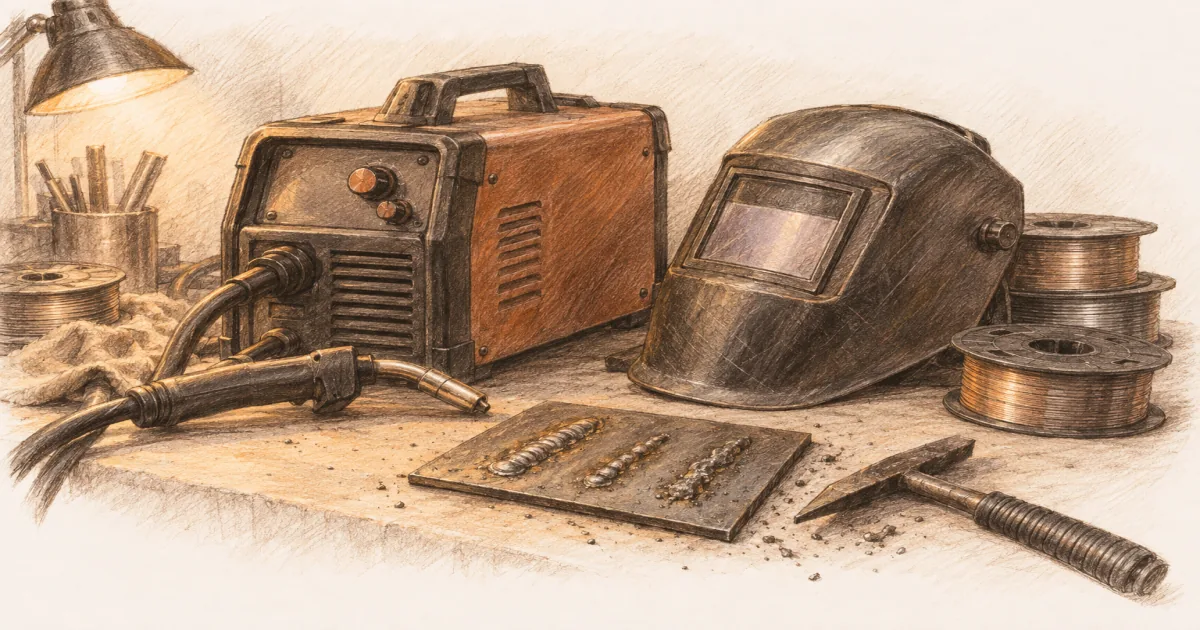
Best Welder for Beginners (2026): Real Picks for First Beads, Trailers, and Garage Repairs
Welders and metalwork
The best welder for beginners is the YESWELDER FLUX-135PRO if you want a synergic 3-in-1 MIG you can carry to the driveway. Choose the BESTMIG kit when you need the helmet and gloves in the same box, and grab the Hpoouo mini stick welder for tight budgets and field repairs.
Our picks
The best welder for beginners is the one that lets you strike a clean bead on your second try, not the one with the longest spec sheet. Most first welds go wrong because the machine asked the beginner to set voltage, wire feed, and gas flow all at once. The picks below take most of that off the table so you can focus on travel speed and gun angle. Browse our welders and metalwork buying guides for more on the topic.
What a first welder actually needs to do
A beginner welder has three jobs and not many more. It needs to strike an arc without the rod freezing to the workpiece. It needs to hold a stable bead long enough for you to watch the puddle form. And it needs to forgive a long list of beginner mistakes: gun held too far back, wire feed set too high, gun angle wrong on the corner of a tube.
Process matters more than brand at this stage. Flux-core MIG is the easiest first process because the wire feeds itself and there is no gas cylinder to set up. Stick is the cheapest first process and the most forgiving on rusty or painted steel.
Lift TIG is the cleanest process but it punishes shaky hands and dirty metal, so leave it for later. Most beginners will be happiest on a 110V flux-core MIG with stick as a backup, then add a TIG torch on a dual-voltage unit once they have a few trailer hitches under their belt.
Power is the other gate. A 110V machine plugs into a standard household outlet, which is what every beginner has in the driveway. A 240V machine welds thicker plate and runs longer duty cycles, but it needs a dedicated circuit in the panel. Start at 110V and only step up when you have a project the 110V machine cannot handle.
How we picked
We picked machines that a beginner can unbox, plug in, and strike a clean bead on within an hour. Synergic control, oversized displays, and a published 110V input are non-negotiable. We skipped units that bury beginners in manual voltage dials, units that require a shielding-gas tank on day one, and units priced above what a first project justifies.
Top pick: YESWELDER FLUX-135PRO
The YESWELDER FLUX-135PRO is the best welder for beginners because it does the most forgiving thing a beginner welder can do, which is match voltage to wire-feed speed automatically. You turn the wire-feed knob to the thickness of the steel, the machine suggests a voltage, and you nudge the voltage by ±3V to taste. That single feature is the difference between an arc that stutters and an arc that lays a clean bead.
It is a true 3-in-1. Flux-core MIG is the workhorse mode and covers 90% of what a beginner welds, from trailer hitches to gate frames. Stick mode handles the rusty repair on the back of the truck or the outdoor job where wind would scatter shielding gas. Lift TIG mode lets you try cleaner welds on clean steel once the basics feel natural, though the TIG torch is sold separately on this variant, so plan on flux-core as your primary use.
The 110V, 135A output welds mild steel cleanly up to about 1/8" in a single pass. Reviewer tests we read show 3/16" plate works with two passes and 1/4" plate is the upper limit before the unit struggles. That covers most home-shop projects: brackets, cart frames, repair plates, exhaust patches, and light trailer work. Anything thicker belongs on a 240V shop machine.
Who it is for: First-time welders who want one machine that grows with them, driveway welders who do not want to drag a gas cylinder around, and anyone fixing trailer hitches, gates, and shop brackets on a $100 budget.
Skip if: You already own a 240V circuit and want to weld 3/8" plate in a single pass, or you want to weld aluminum on day one (this is a flux-core MIG, not a spool-gun MIG).
Shop: YESWELDER FLUX-135PRO on Amazon
Best complete kit: BESTMIG 135A MIG Welder
The BESTMIG 135A kit is the best welder for beginners who do not already own a helmet and gloves. Where the FLUX-135PRO ships the power unit, gun, ground clamp, and wire, the BESTMIG adds the auto-darkening helmet (which flips down into goggles for tight spaces) and a pair of leather gloves that actually fit a US-sized hand. For a first-time welder, that bundle matters more than any spec sheet.
The machine itself is a 3-in-1 in the same way the YESWELDER is, with flux-core MIG as the primary mode, lift TIG as a secondary, and stick as the fallback for outdoor or rusty work. The full-color LED display shows voltage, current, and inductance while you weld, which is the one feature that surprised us most. Most budget welders show one number or none at all. Watching the current climb and fall with travel speed made it easier to find a setting that worked on a specific joint.
The 60% duty cycle at 135A means you can weld for about six minutes out of every ten at full output before the unit pauses to cool, and the thermal overload protection kills the arc before the inverter overheats. The IGBT inverter keeps the arc stable, which is what makes the difference between a bead with consistent penetration and a bead with one cold spot and one burn-through.
Who it is for: First-time welders buying their first helmet and gloves in the same order, weekend hobby welders who want the cleanest setup on a budget, and anyone who values the included full-color display for repeatable settings.
Skip if: You already own an auto-darkening helmet and want to spend the savings on a larger machine, or you specifically want gas-shielded MIG (this kit is flux-core only on the linked variant).
Shop: BESTMIG 135A MIG Welder on Amazon
Best budget portable: Hpoouo 200Amp ARC-200 Stick Welder
The Hpoouo 200A ARC-200 is the best welder for beginners on a tight budget. At under $70 with a $12 coupon on the live listing, it is the cheapest machine on this list by a wide margin, and it ships with everything you need to strike an arc: 20 rods, two chipping hammers, gloves, and the electrode holder. For a beginner who wants to learn on stick before committing to a more expensive MIG, this is the smart first move.
The 20-200A adjustable range covers the full spread of stick welding work. Dial down to 60-80A for 1/16" rods on thin sheet metal, climb to 120A for 1/8" rods on rusty 1/4" plate, and the arc stays stable across the range. The IGBT inverter reacts in microseconds to changes in arc length, so the bead lays down cleaner than the older transformer-style stick welders most beginners learned on.
The real story is portability. At 3.7 lbs and 7.8" x 3.9" x 5.3", the unit fits in a backpack, a toolbox, or the back of a truck. It runs from a standard 110V household outlet without the dedicated 20A circuit a 135A MIG demands. For farm repairs, fence work, rooftop patches, and emergency welds at a job site, that portability is worth more than another 50 amps of output.
Who it is for: Beginners on a sub-$100 budget, anyone who wants to learn stick before stepping up to MIG, and field welders who need to carry the machine to the back of a property.
Skip if: You specifically want flux-core MIG on day one (this unit is stick only) or you want a 110V machine that runs without thinking about amperage (the synergic MIG picks above are easier for first-time welders).
Shop: Hpoouo ARC-200 Stick Welder on Amazon
MIG vs stick vs TIG for first-time welders
For a first welder, flux-core MIG is the most forgiving process on a $100 budget. The wire feeds itself, the machine matches the voltage, and you can practice on scrap steel in the driveway without buying a gas cylinder. Once you have a few projects behind you, add stick as the budget option for outdoor and rusty work, then think about lift TIG only if you have a specific reason to want clean stainless welds.
Stick is the right answer if your first projects are outdoor repairs (gates, fence brackets, trailer hitches), if you are working on rusty or painted steel that flux-core wire would struggle to penetrate, or if you want to spend the least amount of money while you learn. The Hpoouo 200A above is the easiest stick welder to start on because it ships with rods and gloves.
Who should skip a beginner welder
Skip a 110V beginner welder if you regularly weld 3/8" steel plate or thicker. The 135A 110V units on this list can weld 1/4" plate with two passes, but 3/8" and thicker wants a 240V dual-voltage machine like the YESWELDER YWM-160 or an ARCCAPTAIN MIG200. Those cost more and need a dedicated 240V circuit, but they handle the thicker projects in a single pass with cleaner penetration.
Skip all three picks if you specifically want to weld aluminum. None of these units is an AC TIG or spool-gun MIG. Aluminum welding wants AC TIG (for thin sheet) or a spool-gun MIG (for thicker plate), both of which cost more than the beginner 110V machines on this list.
Skip the BESTMIG kit if you already own an auto-darkening helmet and prefer to spend the savings on a larger machine. Skip the Hpoouo if you specifically want flux-core MIG on day one (it is stick only). Skip the YESWELDER if you do not have a 20A outlet available and cannot install one (the unit will trip a 15A breaker under heavy wire feed).
Safety basics for first welds
- Wear an auto-darkening helmet (the BESTMIG kit ships one), leather welding gloves, and a fire-resistant jacket or heavy cotton shirt.
- Weld in a cross-ventilated space so flux-core fumes do not pool around your face. A garage with the door open works fine.
- Keep a fire extinguisher within reach, clear the area of flammables, and put a welding blanket over anything you cannot move.
- Inspect the ground clamp before each session. A loose ground clamp on a painted or rusty surface is the most common cause of a wandering arc.
- Practice on scrap steel first. Lay a 4" bead, chip the slag, look at the cross-section with a grinder, then adjust the wire feed or voltage before welding the real joint.
Bottom line: The best welder for beginners is the YESWELDER FLUX-135PRO for its synergic control, the BESTMIG 135A kit for the included helmet and gloves, or the Hpoouo 200A mini for budget stick welding. Start on flux-core MIG if you can, fall back to stick for outdoor and rusty work, and plan on a 20A outlet for the larger MIG machines. More welder and metalwork guides live on the welding buying guides page and the workshoppicks blog.
Frequently Asked Questions
Is MIG or TIG welding better for beginners?
MIG (specifically gasless flux-core MIG) is the easier first process. The wire feeds automatically, the synergic machines match voltage for you, and you can practice on scrap steel in a driveway without shielding gas. TIG is more about foot control and a clean tungsten tip. Start with MIG or stick and add TIG later if you need clean stainless or aluminum work.
What is the easiest welder to use at home?
A 110V flux-core MIG with synergic control is the easiest first home welder. Plug it into a 20A outlet, load .030" flux-core wire, set the thickness on the dial, and pull the trigger. The BESTMIG 135A kit is the easiest if you also need a helmet and gloves in the same box; the YESWELDER FLUX-135PRO is the easiest if you already own safety gear.
What is the best hobby welding machine for beginners?
For hobby work on trailers, gates, brackets, and small repair jobs, the YESWELDER FLUX-135PRO is the best hobby welder under $150. It runs on 110V, weighs 11.4 lbs, and covers flux-core MIG, stick, and lift TIG in one box. The Hpoouo 200A stick welder is the best hobby welder under $75 when you only need rod welding for outdoor repairs.
Can a beginner stick weld thin metal?
Yes, but start at the low end of the amperage range (around 60-80A on 1/16" rod for sheet metal under 1/8" thick). The Hpoouo 200A lets you dial down to 20A for the thinnest work and up to 200A for 1/8" rod on thicker plate. Use the E6013 rods that ship with it for general mild steel and E6011 rods if the metal is rusty or painted.
Do I need gas for a beginner welder?
No, if you buy a flux-core MIG or stick machine. Flux-core wire has its own shielding built into the core, so you skip the gas cylinder. Gas-shielded MIG gives cleaner welds but adds a tank, regulator, and the need to refill CO/Argon mix. For a first welder, flux-core or stick is the simpler path.
Is 40 too old to learn welding?
No. Most of the beginners we have seen pick up MIG within a weekend of practice, and age does not slow the learning curve the way it limits, say, sprinting. The bigger factors are how often you practice (a couple of evenings a week beats one long session a month) and whether you start on a forgiving machine like the YESWELDER FLUX-135PRO instead of a finicky high-end unit.
How thick can a beginner welder weld?
A 135A 110V flux-core MIG will cleanly weld mild steel up to about 1/8" thick in a single pass and 3/16" with two passes. The YESWELDER FLUX-135PRO lists 3/32" (2.5mm) as its published ceiling, but reviewer tests show it can handle 1/4" plate with care. If you regularly weld thicker than 3/8", step up to a 200A+ 240V machine.
What safety gear do beginners need for welding?
An auto-darkening helmet (the BESTMIG kit ships one), leather welding gloves, a fire-resistant jacket or heavy cotton shirt, closed-toe leather boots, and a clear ventilated workspace. Clear the area of flammables, keep a fire extinguisher within reach, and weld in a space with cross-ventilation so flux-core fumes do not pool around your face.
What is the best welder for learning to weld on a budget?
The Hpoouo 200A stick welder is the best under-$100 welder for learning on a budget. It ships with 20 rods and gloves, weighs 3.7 lbs, and runs from a standard 110V outlet without tripping breakers the way larger 110V MIG machines can. The skill you build on stick transfers to MIG when you step up to a 3-in-1 machine later.
Can I weld a trailer or gate with a beginner welder?
Yes. A 135A flux-core MIG handles 1/8" steel tube and 1/8" flat stock, which covers most light trailer hitches, small gates, and repair brackets. Clean the metal down to bare steel first, set the wire feed to the middle of the recommended range, and lay a practice bead on scrap before committing to the real joint.