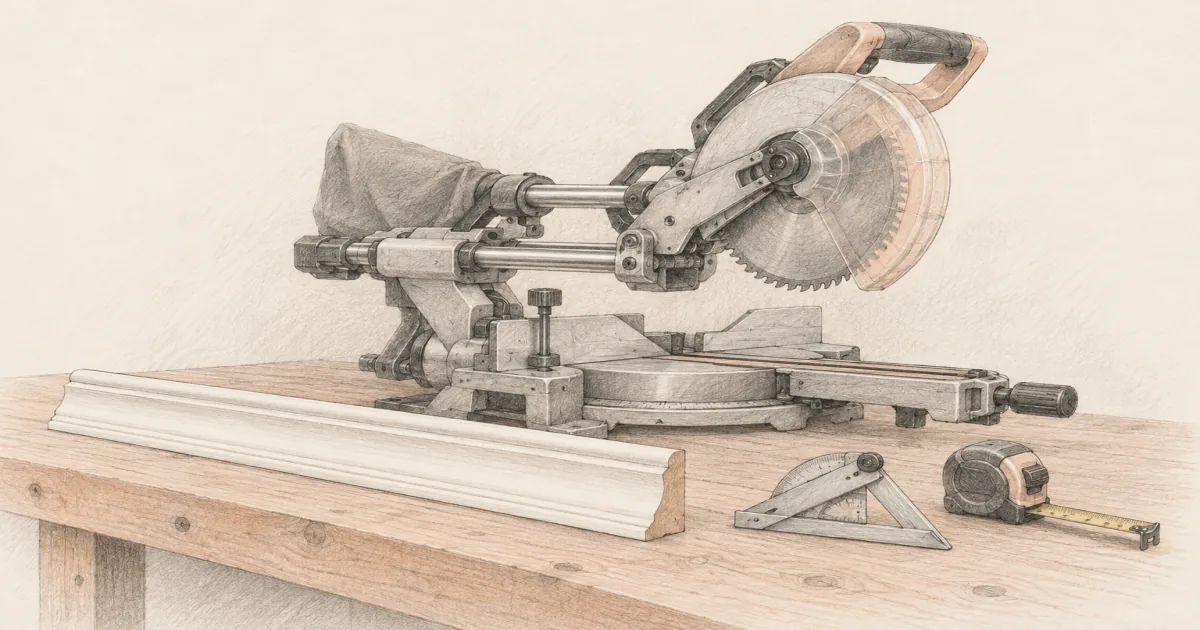
Best Miter Saw for Trim Work (2026): 2 Saws That Cut Clean Coping
Saws
The best miter saw for trim work is the SKIL MS6305-00, a 10-inch dual-bevel slider that cuts base and crown in one pass and stays accurate out of the box. Choose the Metabo HPT C10FCG2 if you want a 24 lb saw for baseboard and casing on a budget.
Our picks
The best miter saw for trim work for most people is the SKIL MS6305-00. Trim is a different job than framing or furniture: the boards are narrow, the angles are fussy, and the saw moves from room to room or sits on sawhorses in a hallway.
That points to a 10-inch slider with a dual bevel and fences tall enough to hold base and crown upright, which is exactly what the SKIL is. If you are still breaking down sheet goods for the built-ins, start with our table saw guide, and browse the rest of our saw guides for the tools that cut alongside it.
What trim work asks of a miter saw
Trim rewards accuracy over raw power. A baseboard joint that is a half degree off shows a gap you will stare at every time you walk past it, so the saw's fence, detents, and blade quality matter more than motor size.
Capacity is the second thing. Baseboard is cut standing up against the fence, and crown is usually cut nested, so the height of the fence and the depth of the cut decide what you can handle. A saw that cannot clear your base in one pass forces you to lay it flat, which changes your angles and slows you down.
Then there is how you mark the cut. A laser line sits beside the blade and can drift; a shadow line throws the blade's actual silhouette onto the board, so what you see is what you cut. On trim, that difference shows up in every corner.
Finally, think about how the saw travels. Trim work happens at the wall, not at a bench, so a 24 lb saw you can carry one-handed often beats a heavier saw that cuts slightly more.
Top pick: SKIL MS6305-00
The SKIL MS6305-00 is the best miter saw for trim because it covers the whole job in one tool. The 10-inch dual-bevel head lets you cut left and right bevels without flipping the molding, so the finished face stays up and your marks stay visible.
The sliding mechanism gives it capacity that a chop saw cannot match. It crosscuts 2x12 at 90 degrees and 2x8 at 45, and the tall sliding fences support 4-1/2 inch base standing up and 6-1/4 inch crown nested. That covers most residential trim in a single pass.
The LED shadow line is the accuracy feature. Instead of a laser beam that sits a hair off the blade, it throws the blade's shadow onto the work, so you line up the cut visually and trust it. The cam miter lock and 11 positive stops make repeat cuts fast once you set your angles.
The tradeoffs are real but manageable. Dust collection is the weak point, so a shop vac on the port or a willingness to sweep is part of ownership. The slide needs rear clearance, which means a built-in miter station needs a cutout or the saw lives on a mobile stand.
Who it is for: Trim carpenters, remodelers, and homeowners installing base, casing, and crown who want dual-bevel capacity without a 12-inch saw.
Skip if: You only trim a room or two a year and want the lightest, cheapest saw that still cuts clean.
Shop: SKIL MS6305-00 on Amazon
Best value: Metabo HPT C10FCG2
The Metabo HPT C10FCG2 is the best value trim saw because it does the common cuts well for about half the price of a slider. The 15-amp motor turns a 40-tooth blade at 5,000 RPM, which leaves clean edges on softwood casing and MDF.
The 24.2 lb body is the reason to buy it. Trim work moves, and a saw this light is easy to carry, easy to set on sawhorses, and easy to store on a shelf. The Xact Cut shadow line and the electric brake are the two features you use on every cut.
It is a compound saw, so it miters 0 to 52 degrees left and right and bevels 0 to 45 degrees to the left. It is rated for 2x6 at 90 degrees and 2x4 at 45, enough for baseboard, casing, and light framing, but not for wide header trim or a 2x8 crosscut.
The limits are the single bevel and the capacity. You will flip the molding for right-side bevels, and you cannot cross a wide board in one pass. If your work is mostly base and casing, neither costs you much time. Backed by a 5-year warranty, it is a low-risk saw to start with.
Who it is for: DIYers and trim carpenters who cut baseboard, casing, and light framing and want a light saw that stores easily.
Skip if: You cut a lot of crown, wide trim, or right-side bevels and want a dual-bevel slider.
Shop: Metabo HPT C10FCG2 on Amazon
How the two trim saws compare
The choice comes down to capacity versus weight. The SKIL gives you the slide and the second bevel, which is what tall base and nested crown need. The Metabo HPT gives you a saw you can carry all day and set up anywhere, which is what a trim punch list usually rewards.
Who should skip these saws
Skip both if you are framing a house or cutting big header stock. A 10-inch saw will get you through 2x6 and 2x8 material, but a 12-inch slider is the right tool for wide dimensional lumber and heavy outdoor trim.
Skip the Metabo HPT if right-side bevels are common in your work. Flipping the molding is not hard, but it is slow, and a dual-bevel saw removes the step entirely.
Skip the SKIL if storage is tight and you cannot give up bench depth. The slide bars need rear clearance, so a wall-hugging station or a shallow shelf will not work without a cutout.
What else you need for clean trim
The saw is half the job. A miter saw protractor or an angle finder pays for itself on the first outside corner, because it reads the actual wall angle and tells you what to set instead of assuming every corner is 90 degrees.
A good blade matters more than a bigger motor. The stock 40-tooth blade is fine for base and casing, but a 60-tooth or 80-tooth finish blade leaves a cleaner edge on painted trim and MDF. Keep a spare so you are never tempted to push a dull blade through.
Clamps and a stable surface keep your fingers away from the blade and your cuts consistent. The vise clamp on the Metabo HPT holds casing well, and a pair of sawhorses or a rolling stand does the rest.
For fastening, a cordless drill or impact driver with a countersink bit drives trim screws without splitting the casing. Our cordless drill guide covers the picks that hold up to a full trim job.
Bottom line: The best miter saw for trim work is the SKIL MS6305-00 for dual-bevel sliding capacity, or the Metabo HPT C10FCG2 for a light, low-cost saw that covers baseboard and casing. More shop guides live on the Workshoppicks blog and the saw guides page. If you are building the trim station first, read our table saw guide.
Frequently Asked Questions
What size miter saw should I use for cutting trim?
A 10-inch saw is the best size for trim. It cuts baseboard and casing cleanly, spins a blade that is easy to find anywhere, and weighs less than a 12-inch saw. Step up to a 12-inch slider only if you cut a lot of nested crown or wide header trim.
What type of saw is best for cutting trim?
A sliding compound miter saw is best for trim. The slide lets you cut wide baseboard and crown without flipping the board, and the compound head handles both miter and bevel angles. A non-sliding chop saw works for narrow casing but runs out of capacity fast.
What kind of miter saw do I need for baseboards?
You need a saw that cuts your baseboard standing up against the fence. A 10-inch dual-bevel slider with tall fences clears a 4-1/2 inch base vertically, which covers most residential baseboard. If your base is taller than that, measure it before you buy.
Do I need a single bevel or dual bevel miter saw for trim work?
Dual bevel is worth it for trim. It lets you cut both sides of a corner without flipping the molding, which keeps the finished face up and your layout marks in view. A single-bevel saw still works, but you will flip every right-side bevel and recheck the orientation more often.
What is a good small miter saw for trim work?
The Metabo HPT C10FCG2 is the best small trim saw. It weighs 24.2 lb, has a carry handle, and spins a 10-inch blade at 5,000 RPM, so it cuts casing and baseboard cleanly while staying easy to move between rooms.
Can I cut crown molding on a 10-inch miter saw?
Yes, if the saw has tall sliding fences. A 10-inch dual-bevel slider with fences that support 6-1/4 inches of nested crown covers most residential crown. Cut it nested against the fence using the crown stops, or cut it flat if you prefer the compound method.
How much does a good trim miter saw cost?
Plan on about $140 for a light single-bevel saw and about $279 for a dual-bevel slider with the capacity for tall base and crown. The extra money goes toward the slide, the second bevel, and the taller fences, which are the features that matter most on trim.
Do I need a stand for a miter saw used on trim work?
A stand helps on long runs and is optional for small jobs. Trim work moves room to room, so a light saw and a pair of sawhorses often beat a heavy stand. If you cut a whole house of baseboard in one spot, a wheeled stand saves your back.