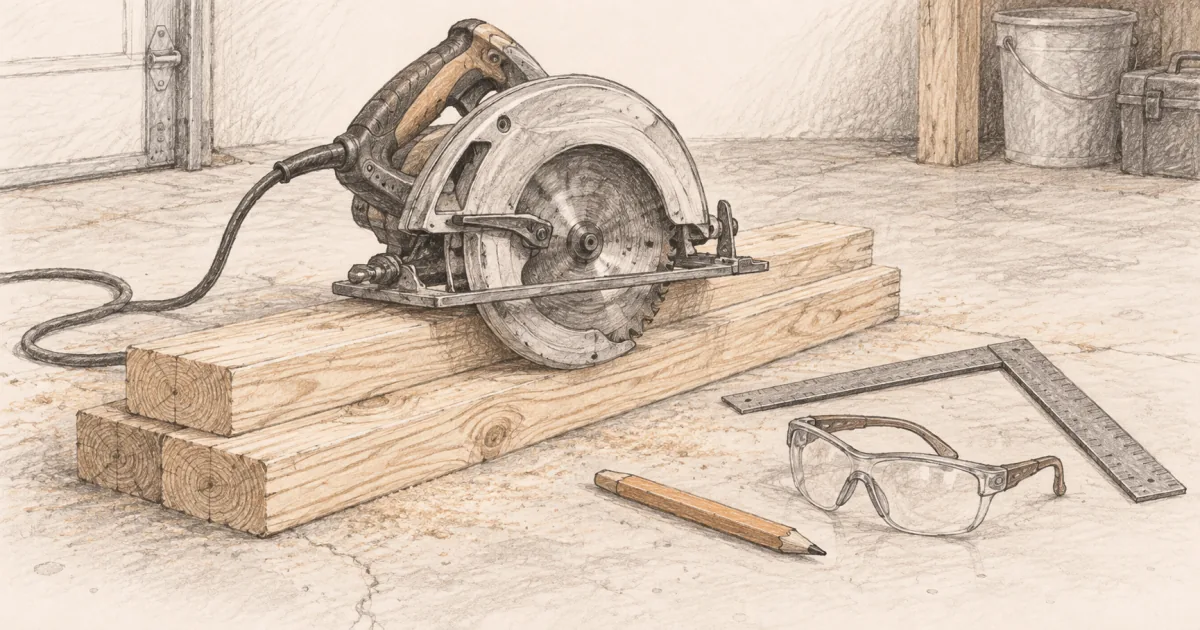
Best Circular Saw for Beginners (2026): 2 Saws to Start On
Saws
The best circular saw for beginners is the DEWALT DWE575SB, a light corded saw with an electric brake that stops the blade fast. The SKIL 5280-01 is the value pick if you want a laser guide and a lower price.
Our picks
The best circular saw for beginners for most people is the DEWALT DWE575SB. It is the saw we would hand someone who has never pulled a trigger on one, because it is light, balanced, and stops quickly when you let go. If your first projects are framing and sheet goods, a circular saw is the natural starting point. Our table saw for beginners guide covers the next step up for repeatable rips, and the saw guides page collects the rest, including the miter saw guide for trim work.
What a beginner should look for in a circular saw
A first circular saw should be easy to control, not the most powerful one on the shelf. Three things decide how it feels, and none of them show up in a big horsepower sticker.
Weight comes first. A saw around 8 to 9 pounds is light enough to guide with one hand along a straight edge without your wrist tiring halfway down a sheet. Heavier saws cut well but punish new users.
The brake comes second. An electric brake stops the blade within a couple of seconds of releasing the trigger, instead of letting it coast. That shortens the window where a moving blade is near your offcut, and it lets you move to the next cut sooner.
Then there is visibility and blade size. A 7-1/4 inch blade cuts 2x lumber in one pass and takes common blades. A laser or a clear sight line helps while you build confidence, though a straight edge matters more than any guide light.
Top pick: DEWALT DWE575SB
The DEWALT DWE575SB is the best first circular saw because it gets control right. At 8.8 pounds it is one of the lightest saws in its class, so you can run it along a straight edge for a whole sheet without fighting the tool.
The 15-amp motor turns at 5,200 rpm and cuts 2-9/16 inches deep at 90 degrees, enough for 2x lumber and sheet goods. The aluminum shoe is stable and holds its setting, and the bevel reaches 57 degrees with positive stops at 45 and 22.5 degrees for common angle cuts.
The electric brake is the feature that matters for a new user. Release the trigger and the blade stops in moments, so you are not waiting on a coasting blade before you move. The lower guard is smooth and the spindle lock makes blade changes simple.
Know the tradeoffs. There is no laser or work light, so you line up the blade by eye or use a straight edge. It also ships with a contractor bag rather than a hard case.
Who it is for: First-time buyers, home DIYers, and anyone who wants one light saw for framing, shelving, and sheet goods.
Skip if: You cut all day on a job site and want a braked saw with a light and a case.
Shop: DEWALT DWE575SB on Amazon
Best value: SKIL 5280-01
The SKIL 5280-01 is the best value for a beginner because it brings a 15-amp motor and a laser guide for well under a hundred dollars. The 7-1/4 inch blade cuts 2x lumber and plywood in one pass, and the saw stays light enough to control with one hand.
The laser guide is the feature that stands out at this price. It is set in line with the blade at the factory, so you can follow a cut line instead of guessing where the blade meets the wood. The dust blower keeps the line clear, which helps most while you are still learning to sight the cut.
The base has sight lines at the front and back for 0 and 45 degree cuts, and the depth adjusts with a quick-release lever. The trigger safety and the on-saw blade wrench are small details that make the saw easier to live with.
Plan around two things. The bevel adjustment is a thumb screw with no fine markings outside the common angles, so angled cuts take a moment. The dust blower also suits outdoor cutting better than an enclosed shop, because it throws chips as it clears the line.
Who it is for: Budget-conscious beginners, occasional users, and anyone who wants a light saw with a guide for framing and small projects.
Skip if: You mostly cut indoors and want dust capture, or you need precise bevel settings.
Shop: SKIL 5280-01 on Amazon
Corded or cordless for a first saw
A corded saw is the right first saw for most beginners. It delivers full power on every cut, it never slows down as a battery drains, and it costs less than a cordless kit once you add a battery and charger.
A cordless saw makes sense if you already own a battery platform, like the DEWALT DCS391B on 20V MAX. It is lighter and easier to carry, and it has a brake and a magnesium shoe. Be aware that it wants a 5Ah or larger pack, because small batteries bog down in thick stock. It is also a 6-1/2 inch saw, so it cuts a little shallower than the corded models.
How to make your first cuts safely
Support the board before you cut it. Set it on sawhorses so both sides of the cut stay supported, and let the offcut fall free instead of pinching the blade. A board that sags in the middle is where kickback starts.
Set the blade depth to just past the thickness of the board. About a quarter inch of blade below the material is enough. That reduces the exposed blade and gives you better control than running it fully raised.
Use a straight edge for long cuts. Clamp a level or a straight board to the workpiece, measure the offset from the blade to the shoe edge, and set the guide that far from your line. Run the shoe against the guide and the cut comes out straight.
Let the blade reach full speed before it touches wood, and keep both hands on the saw. Wait for the blade to stop before you set the saw down. These habits matter more than any single feature on the saw.
Who should skip a basic circular saw
Skip a basic circular saw if your main job is repeatable rips on narrow stock. A table saw holds a fence and repeats a width far better than a circular saw and a straight edge, and it is safer for small parts.
Skip the cordless option if you do not already own that brand's batteries. The tool-only price looks low until you add a battery and charger, at which point a corded saw does the same work for less.
Skip both corded picks if you need dust collection in an enclosed shop. Neither captures dust well, and the SKIL in particular blows chips to clear the cut line. Add a shop vac and a dust port, or cut outside.
Bottom line: The best circular saw for beginners is the DEWALT DWE575SB for its light build and electric brake, with the SKIL 5280-01 as the value pick when a laser guide and a lower price matter more. More shop guides live on the Workshoppicks blog and the saw guides page. If your next step is repeatable rips, start with our table saw guide.
Frequently Asked Questions
What is the best circular saw for a beginner?
The DEWALT DWE575SB is the best first circular saw for most people. It is light at 8.8 pounds, the shoe holds square, and the electric brake stops the blade quickly when you let go of the trigger. The SKIL 5280-01 is the value pick if you want a lower price and a laser guide.
Can a beginner use a circular saw safely?
Yes, with a few habits. Support the board on both sides, let the blade reach full speed before it touches wood, and keep both hands on the saw rather than the offcut. A sharp blade and a straight edge make a beginner safer than a dull blade and freehand cutting.
What size circular saw is best for home use?
A 7-1/4 inch saw is the best size for home use. It cuts 2x lumber and sheet goods in one pass, blades are cheap and easy to find, and the saw stays light enough to control. Smaller 6-1/2 inch saws suit trim and quick cuts.
Corded or cordless circular saw for a first saw?
Start corded unless you already own a battery platform. A corded saw gives full power for every cut and never runs out mid-board. A cordless saw is more convenient, but a small battery pack bogs down in thick stock.
What blade should a beginner put on a circular saw?
A 24-tooth framing blade is fine for rough cuts, and a 40 to 60-tooth blade gives cleaner edges on plywood and trim. Skip very high tooth counts in thick stock, because they cut slowly and can burn. Match the blade to the material and let it do the work.
What is the easiest saw for a beginner to start with?
A circular saw is the easiest power saw to start with, because it is light and handles sheet goods and framing in one tool. A miter saw is easier for repeat angle cuts, and a table saw is better once you need repeatable rips. Most shops add them in that order.
How do I cut a straight line with a circular saw?
Clamp a straight edge to the board and run the saw shoe against it. Measure the offset from the blade to the edge of the shoe, then set the guide that distance from your cut line. This removes the wobble that freehand cuts usually show.