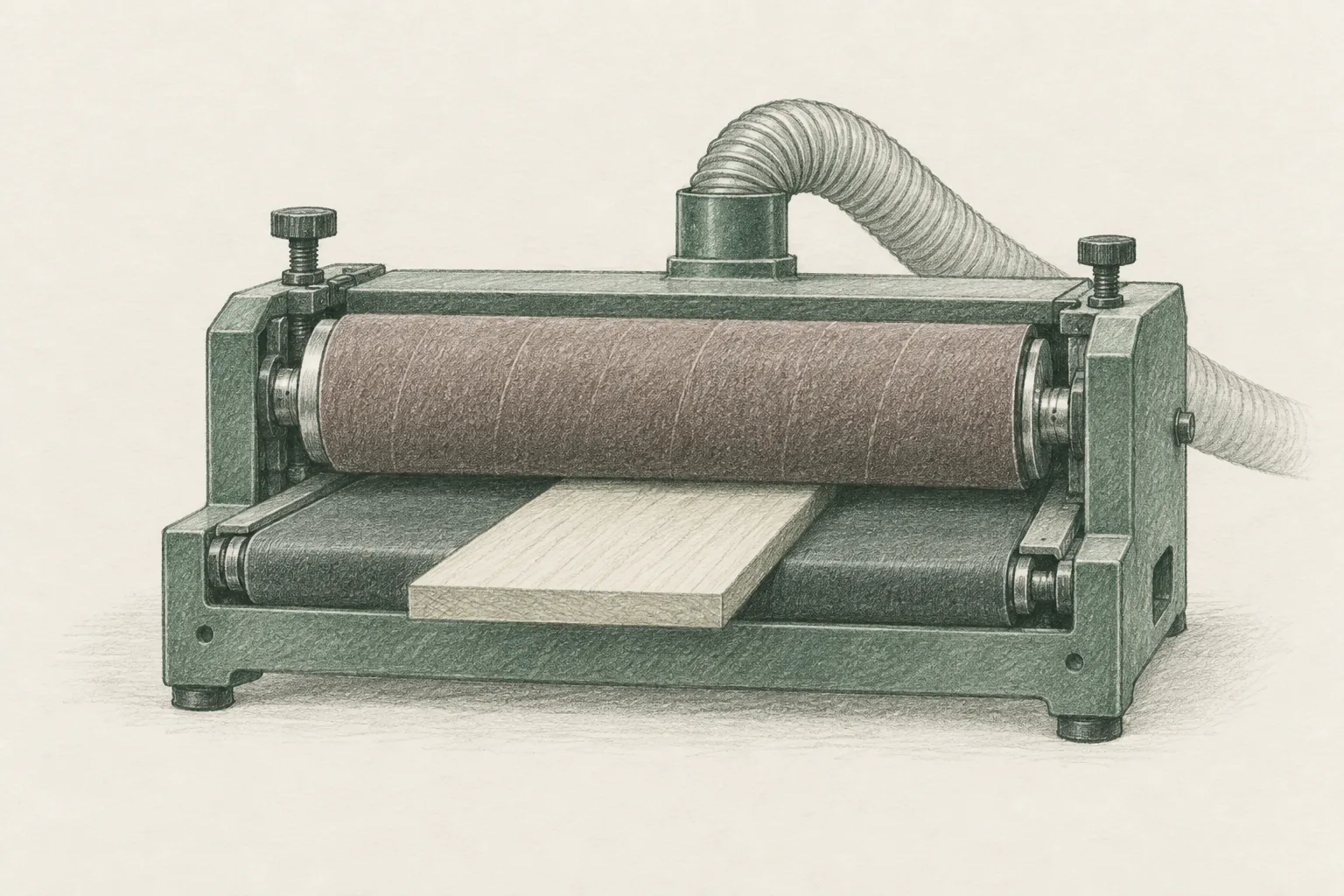
Best Drum Sander for Small Shop (2026): Three JET Picks
Woodworking tools
The best drum sander for a small shop is the JET JWDS-1020, a benchtop machine that sands 10 inches in one pass and 20 in two without eating floor space. The JWDS-1632 and JWDS-2244 are the step ups for wider boards.
Our picks
The best drum sander for a small shop is the JET JWDS-1020. It flattens cutting boards, panels, and glue-ups without taking over the floor, and it sands 20 inches wide in two passes. If you regularly sand tabletops, the JET JWDS-1632 and JWDS-2244 add width. All three live in the woodworking guides, and if you are still thicknessing rough stock, start with our benchtop planer guide and the router guide.
What a drum sander does that a planer cannot
A drum sander is the machine that makes a board flat after the glue-up. A planer sets thickness by cutting the top surface, but it cannot flatten a twisted board or level a cutting board that came out of clamps uneven. The drum sander does that with abrasive wrapped around a spinning drum.
That difference is why the two machines work as a pair. Run rough lumber through the planer to thickness, then run the glue-up through the drum sander to level it. The drum sander removes material slowly, so it is a finishing and flattening tool, not a thicknessing tool.
For a small shop, three things decide which machine fits. Sanding width sets how wide a panel you can flatten, and open-ended designs let you flip the board to double that width in two passes. Dust collection is second, because a drum sander makes a huge volume of fine dust. Floor space is third, which is where benchtop models win.
Get those three right and the machine earns its corner. Get dust collection wrong and you will fight loaded abrasives and bad air.
Top pick: JET JWDS-1020 benchtop drum sander
The JET JWDS-1020 is the best drum sander for a small shop because it packs real flattening power into a benchtop footprint. The 1-horsepower motor spins a 5-inch drum at 1725 RPM, and the open-ended design gives you 10 inches of sanding width in one pass or 20 inches in two.
The self-cooling extruded aluminum drum is the feature that protects your work. By dissipating heat as it sands, it lowers the risk of burning the surface, which is the classic drum sander failure on figured or resinous wood. A precision-flattened steel conveyor bed feeds the board under the drum.
Setup and adjustment stay simple. The parallelism dial brings the conveyor bed back to flat with a turn, and the tool-less abrasive take-up fasteners make changing paper quicker than fighting a clamp. The minimum board thickness is 1/32 inch, so thin veneer work is on the table.
Plan the dust side first. The 4-inch port wants a collector, not a shop vac, and the manual recommends a carrier board for cuts under 1/16 inch. Treat collection as part of the purchase and the machine runs clean.
Who it is for: Hobby shops that flatten cutting boards, panels, and glue-ups and need to save floor space.
Skip if: You sand wide tabletops often, or you have no room for a dust collector.
Shop: JET JWDS-1020 on Amazon
Best for wide boards: JET JWDS-1632
The JET JWDS-1632 is the best drum sander for a shop that sands tabletops and panels. The 1-horsepower drum motor and separate feed motor let the conveyor hold speed under load, and the 16-inch drum sands 16 inches in one pass or 32 inches in two.
SandSmart is the feature that changes how it feels to use. It continuously monitors the drum motor load and automatically regulates the conveyor speed to hold the fastest feed rate the cut allows, so you get a consistent result without slowing down to guess. The drum itself is a dynamically balanced extruded aluminum cylinder with sealed, permanently lubricated bearings.
Dust control is built in. The hood has an integrated channel that mirrors the drum shape and directs chips to the 4-inch port, rated to collect up to 97 percent of the dust. With a real collector, the air stays clear on long sessions.
The honest setup note is belt tracking. The conveyor belt can drift until you tune the tension and tracking, and a few owners spend an evening on it. Once set, it holds, and the machine pays you back with even, snipe-free passes.
Who it is for: Shops that flatten wide boards, tabletops, and cabinet panels and want auto feed control.
Skip if: You only sand narrow stock, or you cannot fit a stand-mounted machine.
Shop: JET JWDS-1632 on Amazon
Best for a bigger shop: JET JWDS-2244
The JET JWDS-2244 is the best drum sander for a shop that regularly works wide. The 1-3/4-horsepower drum motor and the 22-inch open-ended bed take on wide panels, tabletops, and big glue-ups, and the drum runs at a steady speed for an even finish.
The open-ended design is the point. It lets a panel pass under the drum with one side open, so you can sand beyond the drum width by flipping the board. For a shop building tables and countertops, that width saves setups and hand-sanding.
It shares the JET family features that make setup predictable: the tool-less parallelism dial, the dust hood with an integrated collection channel, and the separate feed motor for steady conveyor speed. A dust hose hanger keeps the shop tidy.
Buy it knowing the footprint. It is a floor machine on an open stand, so it needs a corner and a dust collector that can keep up. If your work stays under 16 inches wide, the JWDS-1632 is the better fit and the better value.
Who it is for: Shops that sand wide tabletops, panels, and glue-ups and have the floor space for a stand machine.
Skip if: Your work fits under 16 inches, or you are tight on floor space.
Shop: JET JWDS-2244 on Amazon
How the three drum sanders compare
The pattern is about width and space. The JWDS-1020 is the best benchtop choice for a small shop. The JWDS-1632 adds width and auto feed control on a stand. The JWDS-2244 is the floor machine for wide panels.
Getting flat boards without burn marks
Take light passes. A drum sander removes material slowly on purpose, and a heavy pass loads the abrasive and burns the surface. Start with a shallow depth of cut and let the conveyor do the feeding.
Start coarse, then step up. Use 80 grit to level a glue-up or clear planer marks, then step to 120 and 150. Skipping grits leaves swirl marks that are hard to remove by hand.
Use a backer board for thin stock. The manual recommends a carrier board for cuts of 1/16 inch or less. It supports the workpiece and helps prevent snipe on the leading and trailing ends.
Tune the tension rollers. A line near the end of a board is snipe. Adjust the outfeed roller for a trailing-end line or the infeed roller for a leading-end line, and reduce roller pressure.
Connect real dust collection. A drum sander produces fine dust in volume. A collector on the 4-inch port keeps the abrasive clean, the cut consistent, and the shop air breathable.
Who should skip a drum sander
Skip a drum sander if you do not build flat work. If your projects are framing, shelving, and quick repairs, a random orbital sander and a good planer cover you, and the drum sander would sit idle.
Skip the JWDS-2244 if your panels fit under 16 inches. The JWDS-1632 is the better fit and leaves floor space for something else.
Skip all three if you have no dust collection. A drum sander without a collector is a dust storm, and it will foul abrasives and your lungs. Budget for the collector as part of the machine.
Bottom line: The best drum sander for a small shop is the JET JWDS-1020 for tight spaces, the JET JWDS-1632 for wide boards, or the JET JWDS-2244 for big glue-ups. More shop guides live on the Workshoppicks blog and the woodworking guides page. If you are still thicknessing rough lumber, read our benchtop planer guide.
Frequently Asked Questions
What is the best drum sander for a small shop?
The best drum sander for a small shop is the JET JWDS-1020. It is a benchtop machine that sands 10 inches in one pass or 20 inches in two, so it flattens panels without taking over the shop. If you sand wide tabletops, the JET JWDS-1632 is the step up.
What is a drum sander used for?
A drum sander flattens and thickness-sands boards, panels, and glue-ups. It takes the machine marks out of a planer and levels a cutting board or tabletop after glue-up. It is not a substitute for a planer; the planer sets thickness, and the drum sander smooths and levels.
Do I need a dust collector for a drum sander?
Yes. A drum sander makes a large volume of fine dust, and a small shop vac cannot keep up. Use a dust collector with at least 400 CFM on the 4-inch port. Without real collection the abrasive loads up, the finish suffers, and the air gets bad fast.
Can a drum sander replace a planer?
No. A planer sets the thickness of a board by cutting the top surface, while a drum sander levels and smooths with abrasive. A drum sander removes material slowly, so using it to thickness rough lumber would take forever and burn through abrasives. Use both, in that order.
How wide a board can a drum sander sand?
It depends on the model. The JET JWDS-1020 sands 10 inches in one pass or 20 inches in two. The JWDS-1632 sands 16 inches in one pass or 32 in two. The JWDS-2244 sands 22 inches in one pass. Open-ended machines let you flip the board for the second pass.
What grit should I start with on a drum sander?
Start around 80 grit to level a glue-up or remove planer marks, then step to 120 and 150 to finish. Take light passes and let the conveyor feed the board. Jumping from 80 straight to 220 leaves swirl marks that are hard to sand out by hand.
Why does my drum sander leave a line across the board?
A line near the end of a board is snipe, usually from too much tension roller pressure. Adjust the infeed roller for a leading-end line or the outfeed roller for a trailing-end line. Light passes and a backer board for thin stock also help.
Is a drum sander worth it for a hobby shop?
Yes, if you build cutting boards, tabletops, or panels and you are tired of hand-sanding them flat. It saves hours of sanding and gives a more even surface than a random orbital sander alone. If you mostly cut framing lumber, it is not worth the space.