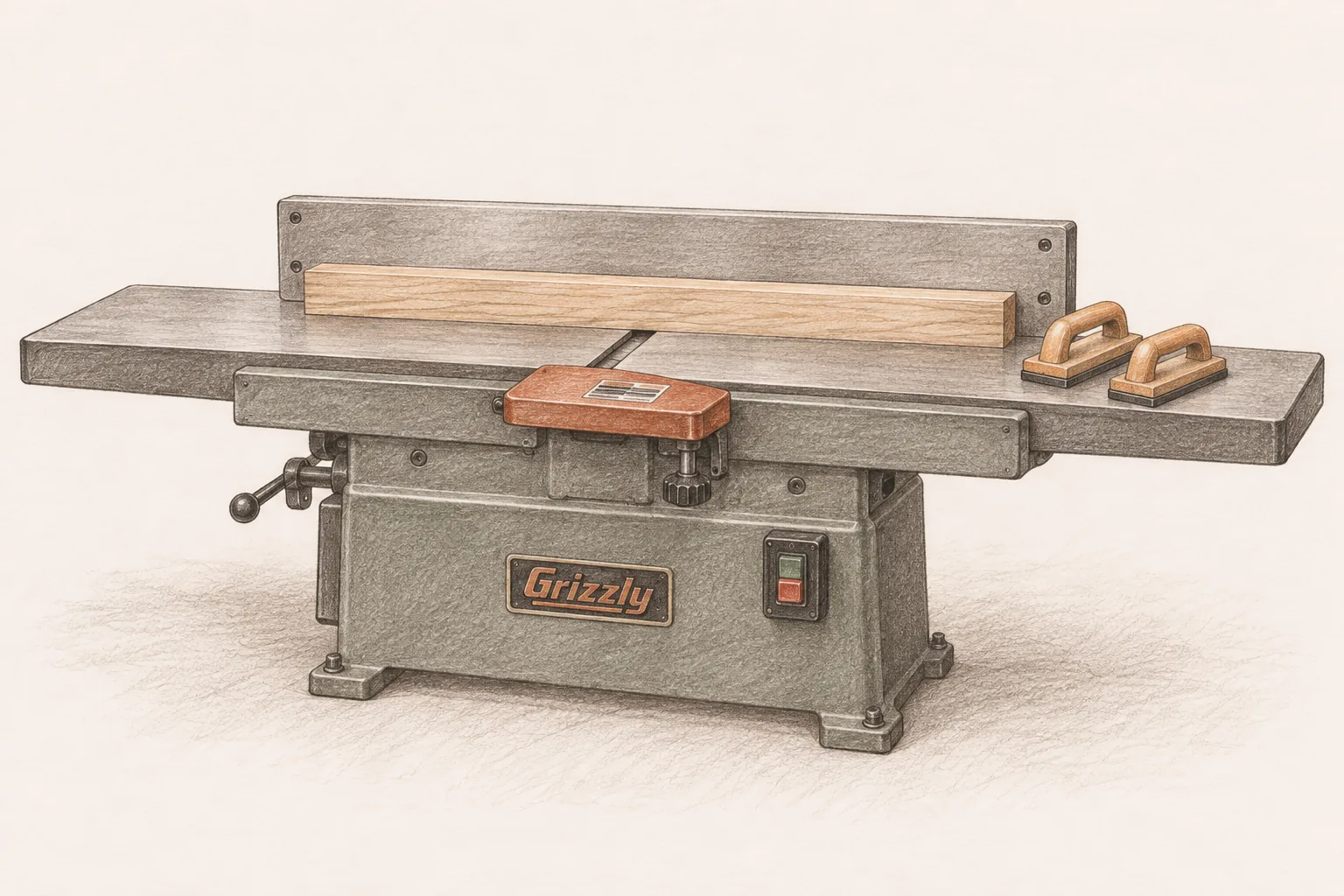
Best Jointer for Small Shop (2026): Three Benchtop Jointers
Woodworking tools
The best jointer for a small shop is the WEN JT833H, an 8-inch spiral benchtop with a table that extends to 51 inches. The Wahuda 6-inch is the compact pick, and the Cutech 12-inch flattens wide boards.
Our picks
The best jointer for a small shop is the WEN JT833H. It gives you an 8-inch cut, a spiral head that handles figured wood, and tables that stretch to 51 inches without a floor footprint. If space is tighter, the Wahuda 6-inch is the compact choice. If you face wide panels, the Cutech 12-inch is the one. All three live in the woodworking guides, and if you are also thicknessing boards, pair them with our benchtop planer guide and the router guide.
What a jointer adds to a small shop
A jointer makes one face and one edge of a board flat and square. That sounds small, but it is the reference every other step depends on. A planer can make a board an even thickness, but it cannot flatten a cupped or twisted board on its own, because it copies the board's warp from the other side.
That is why the jointer comes first. You flatten one face on the jointer, square one edge, then let the planer bring the board to thickness with the flat face as a reference. Skip the jointer and you build furniture from boards that rock and gaps that show up at glue-up.
For a small shop, three specs matter. Cut width sets how wide a board you can face, and 6-inch, 8-inch, and 12-inch benchtop machines cover different work. Table length sets how well you can support a long board, which is why extendable tables help. Cutterhead type sets the finish and the maintenance, with spiral heads cutting cleaner and needing less sharpening than straight knives.
Get those right and a benchtop jointer does the job of a floor model in a fraction of the space.
Top pick: WEN JT833H 8-inch spiral jointer
The WEN JT833H is the best jointer for most small shops because it gives you an 8-inch cut with tables that support real stock. The 10-amp motor turns the cutterhead up to 12,000 RPM, and the spiral cutterhead uses 16 staggered HSS blades for a fine finish on hard and soft woods.
The extendable table is the feature that sells it. The table measures 33 by 8 inches and the support arms extend it to 51 inches, so long boards do not sag off the end. That is what keeps the jointed edge straight from end to end.
Depth control is simple: adjust the infeed table to remove 0 to 1/8 inch per pass, with an onboard depth-of-cut scale. The fence bevels to 45 degrees for angled edge work, and a spring-loaded blade guard exposes only a small section of the cutterhead.
Know the quirks. The fence needs patience to square and a periodic nudge back to 90. The HSS inserts dull faster than carbide. Neither is a dealbreaker, and both are normal at this price.
Who it is for: Small shops that flatten and square boards up to 8 inches wide and want long-table support.
Skip if: You face wide panels, or you want a fence that never needs adjusting.
Shop: WEN JT833H on Amazon
Best compact: Wahuda Tools 6-inch jointer
The Wahuda 6-inch is the best compact jointer for a small shop. The 10-amp, 120-volt motor runs the cutterhead at a fixed 12,000 RPM, and the spiral head carries 12 four-sided carbide inserts that rotate in place when they dull.
The cast-iron tables and the 19-5/8-by-4-3/8-inch fence are the value here. Cast iron holds its flatness and damps vibration, and the fence tilts from 90 to 135 degrees for angled work. The spiral head cuts quieter than a straight-knife machine and leaves a cleaner surface on figured stock.
The footprint is the other selling point. At just over 17 inches deep and 13 inches tall, it fits a bench in the smallest shop. It ships with push blocks and the tools to adjust it.
Plan around the width and length limits. A 6-inch cut width handles edge jointing and narrow stock but not wide panels, and with no extension rods a long board needs support. For edge work in a tight shop, it is a strong machine.
Who it is for: Tight shops that mostly edge-joint and square narrow stock and want a quiet, low-maintenance cutterhead.
Skip if: You need to face wide panels, or you joint long boards often.
Shop: Wahuda 6-inch on Amazon
Best for wide boards: Cutech 12-inch spiral jointer
The Cutech 12-inch is the best jointer for a small shop that works wide. The 12-amp motor is the most powerful in the benchtop class, and the spiral cutterhead holds 24 two-sided tungsten carbide inserts set in six rows for a smooth finish with a low amp draw.
Width is the reason to buy it. A 12-inch cut lets you face wide panels and glue-ups in one pass instead of jointing in sections. The 24-by-6-inch cast-iron fence has quick stops at 90 and 135 degrees, and the fence enhancement brackets add support for tall work.
The cast-iron tables and the spiral head keep the finish clean on figured wood, and the two-sided inserts sit in alignment to resist skewing. For a shop building tabletops and wide panels, that width is worth the price.
Buy it knowing the room it wants. It is bigger and louder than the 6-inch and 8-inch machines, so give it a solid bench and hearing protection. If your work fits under 8 inches, the WEN JT833H is the better value.
Who it is for: Small shops that face wide panels and glue-ups and want the widest cut in the benchtop class.
Skip if: Your boards fit under 8 inches, or you work in a noise-sensitive space.
Shop: Cutech 12-inch on Amazon
How the three jointers compare
The pattern is about width. The WEN JT833H is the best all-around benchtop jointer for an 8-inch shop. The Wahuda is the compact, quiet pick for edge work. The Cutech is the wide machine for panels.
Setup tips for a benchtop jointer
Square the fence first. Check it against the table with a machinist square and adjust before your first cut, then recheck it now and then. A fence that drifts off 90 degrees will give you a tapered edge no matter how careful you feed.
Set a light depth of cut. Take 1/32 inch per pass on figured wood and no more than 1/8 inch on straight grain. Light passes reduce tearout and let the motor hold speed.
Feed with steady pressure. Push the board onto the outfeed table and keep pressure on the outfeed side as it passes the cutterhead. Uneven pressure is the main cause of taper and cupping.
Use push blocks. A jointer's cutterhead is exposed during a pass, so use push blocks on every board, especially short stock. Keep your hands behind the guard.
Wax the tables. A slick table feeds smoother and resists rust. A coat of paste wax on the cast-iron tables makes a noticeable difference on long boards.
Who should skip a benchtop jointer
Skip a jointer if you only buy dimensioned lumber. If every board arrives flat and square, the jointer would sit unused, and a planer alone covers thicknessing.
Skip the 6-inch machine if you face wide panels. The 8-inch WEN or the 12-inch Cutech is the better fit, and jointing in sections is slow.
Skip the 12-inch machine if your work fits under 8 inches. It costs more and takes more room than you need.
Bottom line: The best jointer for a small shop is the WEN JT833H for an 8-inch cut and long-table support, the Wahuda 6-inch for compact edge work, or the Cutech 12-inch for wide boards. More shop guides live on the Workshoppicks blog and the woodworking guides page. If you are flattening and smoothing next, read our drum sander guide.
Frequently Asked Questions
What is the best jointer for a small shop?
The best jointer for a small shop is the WEN JT833H. It is an 8-inch spiral benchtop with a table that extends to 51 inches, so it flattens and squares boards without taking up a floor footprint. If your shop is very tight, the Wahuda 6-inch is the compact pick.
What does a jointer do that a planer does not?
A jointer makes one face and one edge flat and square, which is the reference a planer needs. A planer then cuts the opposite face to a uniform thickness. You need both: the jointer creates a true flat reference, and the planer uses it to make the board even.
What size jointer should I buy for a small shop?
Buy an 8-inch benchtop jointer for the best balance of width and space. A 6-inch jointer is enough for edge work and narrow stock, while a 12-inch machine faces wide panels. Benchtop models run on 120 volts and fit on a bench.
Can you joint a board wider than the jointer?
Yes, with a technique called jointing in sections. You run one side, then flip the board end for end and run the other side, using the fence as a reference. An open-ended design makes it easier. For frequent wide work, a 12-inch jointer is simpler.
Why does my jointer leave a cupped or tapered board?
Cupping and taper come from feeding with uneven pressure or from a fence that is not square to the table. Keep steady downward pressure on the outfeed side, and check the fence with a square before each session. Set a light depth of cut.
How often do I need to sharpen jointer blades?
With a spiral head and carbide inserts, rotate or replace an insert only when the cut dulls or chips, which can be thousands of board feet. Straight-knife heads need sharpening far more often. HSS inserts dull faster than carbide.
Is a benchtop jointer worth it?
Yes, for a small shop that builds furniture, cutting boards, or trim. A benchtop jointer flattens and squares stock at a fraction of the price and footprint of a floor model. If you only buy dimensioned lumber, you can skip it.
What is the difference between a spiral and a straight-knife cutterhead?
A spiral cutterhead holds many small inserts set at an angle, so it shears the wood fiber and cuts quieter with less tearout. A straight-knife head uses two or three long knives and can tear out figured wood. Spiral heads cost more but need less maintenance.