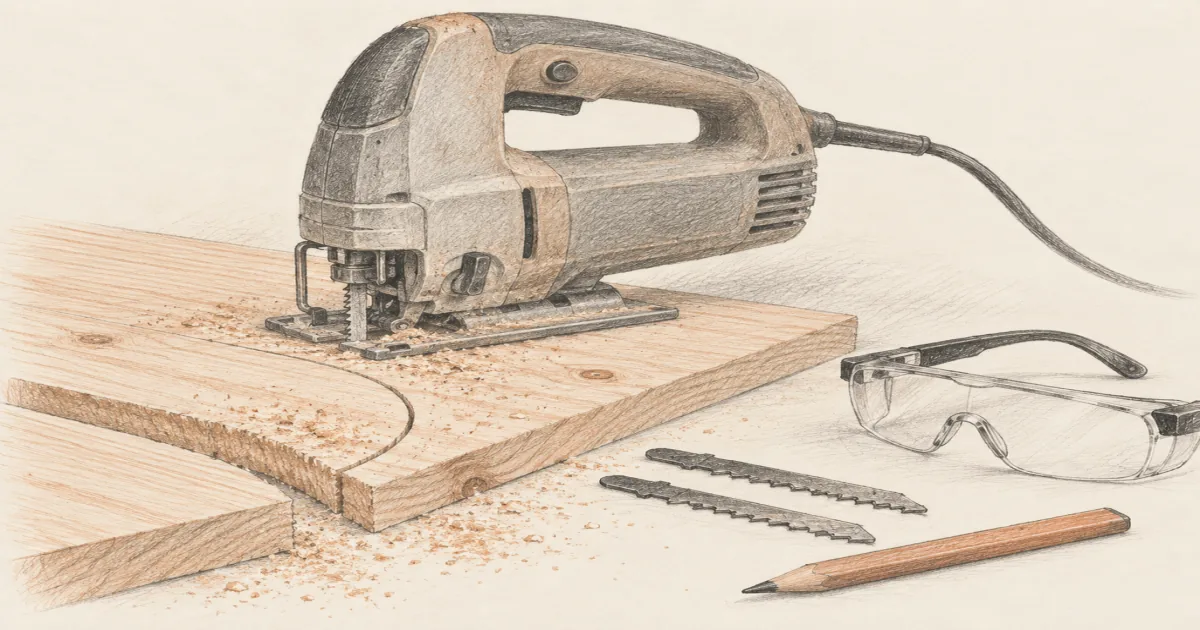
Best Jigsaw for Beginners (2026): 3 Saws for Clean First Cuts
Saws
The best jigsaw for beginners is the Bosch JS470E, a smooth seven-amp saw with tool-free blade changes. The SKIL JS314901 is the value pick, and the BLACK+DECKER BDEJS300C is the cheapest way to start.
Our picks
The best jigsaw for beginners for most people is the Bosch JS470E. A jigsaw is the saw that cuts the shapes other saws cannot reach, and the JS470E makes that job feel controlled instead of twitchy. It is the saw we hand a new woodworker who wants to cut curves, sink a sink opening, or trim a shelf to fit. If your first projects are straight cuts in sheet goods, start with our circular saw for beginners guide instead, and browse the rest on the saw guides page.
What makes a jigsaw easy to start on
A first jigsaw should be smooth and easy to steer, not the most powerful saw on the shelf. Three things decide how it feels in your hands, and none of them show up in a big amp number.
Blade guidance comes first. A saw with roller guides holds the blade steady, so it follows your line instead of wandering in thick stock. Cheap saws skip the rollers, and you feel it the moment you cut a curve.
Blade changes come second. A tool-free clamp lets you swap a blade in seconds and eject a hot one without touching it. On a saw with a hex key, every blade change is a small project of its own.
Then there is the trigger and the light. A variable-speed trigger lets you start slow and build speed, which is what keeps a first cut on the line. A light and a dust blower keep that line visible while you work.
Top pick: Bosch JS470E
The Bosch JS470E is the best jigsaw for most beginners because it gets the two hard parts right: blade control and blade changes. The seven-amp motor drives a stroke that stays smooth under load, so the saw does not chatter when the blade meets a knot or a curve.
The roller blade guides are the reason curves come out clean. They support the blade on both sides and cut down the side-to-side wander that turns a smooth arc into a jagged one. The tool-free clamp takes T-shank and U-shank blades and ejects them without your fingers near a hot edge.
Speed and orbit are both adjustable. The variable-speed trigger runs from about 500 to 3,100 strokes per minute, and four orbital settings let you switch between a clean, non-orbital cut and a fast roughing cut. A dust blower keeps the line clear, and an ambidextrous trigger lock makes long cuts easier to manage.
Know the tradeoffs. The bevel base has no firm detents, so you check 0 and 45 degrees with a square after any bevel change. It is also heavier than a budget saw, which you notice on long cuts overhead.
Who it is for: Beginners and home woodworkers who want one saw for curves, cutouts, and clean trim cuts.
Skip if: You only cut straight lines in sheet goods, or you want the lightest possible saw for overhead work.
Shop: Bosch JS470E on Amazon
Best value: SKIL JS314901
The SKIL JS314901 is the best value for a beginner because it packs the features that help new users for around fifty dollars. The six-amp motor cuts plywood, 2x lumber, and light sheet metal, and the four-stage orbital selector lets you trade speed for a cleaner edge.
The halo light is the standout. It casts a bright ring around the blade so you can see the line, even in a dim corner of the shop. The dust blower works with it to keep sawdust off the line, which is when a first cut usually goes wrong.
Blade changes are tool-free, and the clamp holds T-shank blades securely and ejects them without finger contact. The shoe bevels to 45 degrees for angled cuts, and the shoe held its setting through our test cuts.
Plan around two things. The trigger area gets warm during long, continuous cuts, so take breaks or wear gloves. There is also no vacuum port, so the blower clears the line but fine dust still settles on the bench.
Who it is for: Budget-conscious beginners, weekend DIYers, and anyone cutting plywood, trim, and light metal around the house.
Skip if: You cut for hours at a time, or you need a dust port for an enclosed shop.
Shop: SKIL JS314901 on Amazon
Cheapest easy start: BLACK+DECKER BDEJS300C
The BLACK+DECKER BDEJS300C is the cheapest way to start cutting with a jigsaw. The 4.5-amp motor makes up to 3,000 strokes per minute, enough for 1x stock, plywood, and light metal, and the saw weighs a little over four pounds so it is easy to control.
The wire-guard sightline channel is the feature that helps beginners most. It gives you a clear view of the blade meeting the wood, so you can follow a line instead of cutting blind. The dust blower keeps that view usable, and the shoe bevels to 45 degrees for angled cuts.
The blade clamp is tool-free and takes both U-shank and T-shank blades, so the spare blades you already own likely fit. At this price, that kind of compatibility matters.
Buy it knowing what it is. There is no orbital action, so it cuts more slowly in thick stock, and the base plate is plastic rather than metal. For occasional home projects it is a smart buy. For daily shop work it is not the saw.
Who it is for: First-time buyers, renters, and anyone who wants a light saw for small repairs and craft projects.
Skip if: You cut thick hardwood, or you want one saw that will take years of shop abuse.
Shop: BLACK+DECKER BDEJS300C on Amazon
How the three jigsaws compare
The pattern is simple. The Bosch is the saw to buy if you want the smoothest cuts and you plan to use it for years. The SKIL gives you most of the control and all of the visibility for a fraction of the price. The BLACK+DECKER is the saw to buy when the budget is tight and the projects are small.
How to cut clean curves with a jigsaw
Start with the right blade. A narrow scroll blade turns tight curves, while a wider clean-cut blade holds a straighter line. Match the blade to the curve radius, and change it when it dulls instead of pushing harder.
Turn the orbital action down for visible edges. Orbital action speeds up rough cuts, but it also roughens the edge. For a shelf front or a visible curve, run the saw in non-orbital mode and let the blade take its time.
Go slow into the curve. Push the saw along the line rather than twisting it, and keep the base flat on the wood. Forcing the saw is what bends the blade and sends the cut off the line. Support the offcut so it does not pinch the blade as you finish.
Drill a starter hole for inside cutouts. A jigsaw cannot plunge into the middle of a board, so drill a hole inside the shape, feed the blade through, and cut out from there. That trick opens up sink cutouts, outlet boxes, and window openings.
Who should skip a jigsaw
Skip a jigsaw if every cut you make is a straight rip. A circular saw or a table saw cuts long, straight lines faster, and both hold a line better than a jigsaw with a straight edge. The jigsaw earns its place on curves and cutouts, not on ripping.
Skip the budget saw if you are cutting hardwood regularly. The BLACK+DECKER is a light-duty tool, and thicker stock will slow it down and wear it out. Spend up to the SKIL or the Bosch if your projects are more than occasional.
Skip the corded saws if you work away from power or on a job site all day. A cordless jigsaw on a battery platform you already own is more convenient, though you give up some power and pay more for the kit.
Bottom line: The best jigsaw for beginners is the Bosch JS470E for smooth curves and clean edges, with the SKIL JS314901 as the value pick and the BLACK+DECKER BDEJS300C as the cheapest easy start. More shop guides live on the Workshoppicks blog and the saw guides page. If your next step is straight cuts in sheet goods, read our circular saw guide.
Frequently Asked Questions
Is a jigsaw good for beginners?
Yes, a jigsaw is one of the easiest power saws to start with. It cuts curves, circles, and cutouts in sheet goods and boards, and the blade is small enough to control by hand. You do not need a big table or a lot of space, which makes it a natural first saw for a garage shop.
What is the best jigsaw for the money?
The SKIL JS314901 is the best jigsaw for the money for most beginners. It brings a bright halo light, a two-finger trigger, and tool-free blade changes for around fifty dollars. Step up to the Bosch JS470E if you want smoother cuts and can spend more.
What is the difference between a regular jigsaw and an orbital jigsaw?
An orbital jigsaw adds a forward push to the blade as it strokes, so it cuts faster through wood. A regular, non-orbital cut is slower but leaves a cleaner edge. Most jigsaws let you turn the orbital action off for clean work and on for fast rough cuts.
Do I need a corded or cordless jigsaw?
Start corded unless you already own a battery platform. A corded jigsaw gives full power on every cut and never needs a charge, and it costs less than a cordless kit once you add a battery. A cordless saw is handy for trim work away from an outlet.
What blades does a beginner need for a jigsaw?
Start with a scroll blade for curves, a clean-cut wood blade for visible edges, and a metal blade for thin sheet or pipe. Buy T-shank blades, because they fit the tool-free clamps on most current saws. A sharper blade does more for your cuts than any saw setting.
How do I cut a straight line with a jigsaw?
Clamp a straight edge to the board and run the saw base against it. A jigsaw blade wanders on its own, so the guide does the work. Keep the speed moderate and let the blade cut rather than forcing the saw, which is what bends the cut.
Which is better, a DeWalt or Bosch jigsaw?
Both are good, and the pick depends on the job. Bosch jigsaws are known for smooth curves and clean edges, which suits furniture and trim. DeWalt saws are common on job sites and share batteries with the rest of the DeWalt 20V line, which matters if you already own those packs.