Best Tool Chest for Garage (2026): 2 Rolling Chests Worth Buying
Workbenches and storage
The best tool chest for garage work is the Goplus 5-drawer rolling chest, a compact lockable cart that holds a full set of hand tools and rolls out of the way. Choose the Sormols 13-drawer 2-in-1 if your collection has grown past one cabinet.
Our picks
The best tool chest for garage work is the Goplus 5-drawer rolling tool chest, because it stores the tools a home garage actually uses, rolls under a bench overhang when you are done, and costs far less than a pro-brand stack. A tool chest is not glamorous gear, but it is the difference between a five-minute repair and a twenty-minute hunt.
Two numbers decide which chest fits your garage: the drawer load and the floor space in front of it. Both are covered below, because they are easy to miss on the product page.
Our workbench and storage guides cover the rest of the setup, and the workbench guide is the natural partner if you need a surface to work on first. A shop light makes the drawers readable, and a dust collection system keeps the tools in them clean.
What to look for in a garage tool chest
Three things matter on a home chest: the drawer slides, the casters, and the steel. Ball-bearing slides carry weight and stay smooth after thousands of openings. Casters, at least two of them locking, let you roll the chest to the job and park it firm. The steel on a budget chest is thinner than a mechanic's box, and that is fine for home use.
Do you need ball-bearing drawer slides?
Yes, if you open the drawers often. Ball-bearing slides roll smoothly under weight and last far longer than friction slides. On a budget chest the slides matter more than the brand name on the front.
How much room does a full drawer pull need?
A drawer pull needs its own travel plus a hand in front of the chest. The Goplus body is 11 inches deep, so a drawer comes out about 11 inches, and 12 inches of clear floor is enough. A 24 inch wide chest against a wall still wants two feet of open floor in front.
What is the difference between a tool chest, a cabinet, and a cart?
A tool chest is the drawer box that sits on top, a cabinet is the wider base with doors and deep drawers, and a cart is a small open tray on wheels for the job in progress. A 2-in-1 chest such as the Sormols is a chest bolted to a cabinet.
The rest is layout. A lift-off top box is handy when you want a handful of tools at the bench. A lock bar keeps drawers shut while you roll. Bottom cabinets or deep drawers give bulky items a home so the top drawers stay for hand tools.
Do not overbuy. A chest with more drawers than you can fill just collects clutter. Match the box to the tools you own today.
How much weight will the drawers actually take?
The Goplus rates each drawer at about 11 lb and the whole chest at 220 lb. That is enough for screwdrivers, wrenches, pliers, and meters, but not enough for a drawer packed with deep sockets, which is why the bottom cabinet exists.
The per-drawer number is the one that surprises people. Eleven pounds is roughly a full 3/8 inch socket set with a ratchet, or two hammers, or a tray of drivers. Spread the sockets across two drawers and put the breaker bar and the big wrenches in the bottom cabinet, and you stay inside the rating without thinking about it.
Where should the heavy tools go?
Heavy tools go low and toward the middle. A loaded top drawer raises the center of gravity on an 11 inch deep cart, which is the shape that tips when two drawers are open at once. The bottom cabinet on the Goplus has a three-level shelf, and that shelf is the right home for a circular saw, a grinder, or a case of drills.
The Sormols takes the same approach with more room. Its 73 lb empty body is heavier than the Goplus, and its seven large drawers carry a socket collection that would overload the smaller chest. Load the double-door cabinet first, then the large drawers, then the small ones, so the weight sits over the casters rather than above them.
How much does the chest weigh when it is full?
A 220 lb total rating minus the chest's own weight leaves the real budget: roughly 180 lb of tools on the Goplus. That is a full set of hand tools, two drills, and a sander, which matches what owners report fitting. A mechanic's roll cab carries several times that, and costs several times as much.
The missing numbers on the Sormols are worth noticing. When a maker does not publish a load rating, treat the chest as a hand-tool cabinet and keep the power tools in the bottom, where the steel and the casters can take them.
Will it fit under a workbench or in a 24 inch gap?
Neither chest slides under a standard bench. The Goplus is 40 inches tall and the Sormols 43.3 inches, so both stand beside the bench rather than under it. What they do fit is a narrow gap: 11 inches of depth on the Goplus and 13 on the Sormols.
That shallow depth is the design. Both chests are tall and thin, built to sit against a wall between the bench and the door, with the drawer face toward open floor. The Goplus at 23.5 inches wide by 11 inches deep takes less floor than a bicycle.
Measure the height of your bench apron before you order, not just the floor space. A 40 inch chest next to a 36 inch bench is fine. A 43 inch chest next to a bench with a vise on the corner can crowd the swing of the vise handle, so leave the corner clear.
Why will the drawers not open on a new chest?
On the Goplus, the top lid has to be open before any drawer will slide. The latch lives in the lid hinge, and a closed lid holds the drawers shut on purpose so they cannot roll open in transit. Open the top first, then pull a drawer. If it still will not move, check that the chest is level.
It is the complaint owners mention most often, and it is not a fault. It is a latch nobody documented well. Owners also describe a second surprise: the keyed lock covers the top compartment only, so the drawers are held by the lock bar rather than the key.
How long does assembly take?
About 15 minutes with the included 10 mm wrench. The body ships assembled, so you are fitting four casters, a side handle, and a hook rack. The slow step on the Goplus is the pair of rear bolts under the top drawer, where the holes are hard to see and you are working by feel.
The Sormols arrives with its top box nested inside the bottom cabinet, which is how it survives shipping. Freeing it means taking off the side and bottom panels first, so plan a spot to set the top box down before you start. Give it a clear half hour rather than the 15 minutes the manual quotes.
Top pick: Goplus 5-drawer rolling tool chest
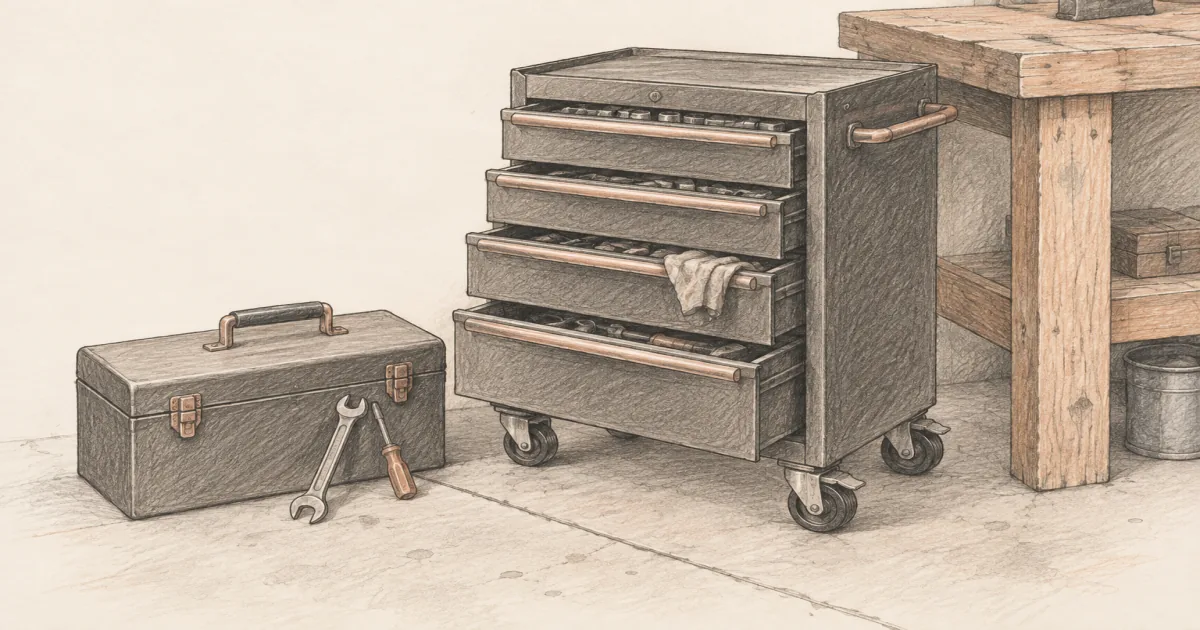
The Goplus 5-drawer rolling tool chest is the best pick for most home garages because it does the basics without extra bulk. Five drawers sit under a lift-off top box, and the 23.5 by 11 by 40 inch body fits against a wall or beside a bench. The EVA liners are already in the drawers, so tools do not slide or rattle when you move the cart.
What fits in five drawers plus a top box?
Five drawers take a standard mechanics set, a driver set, pliers, and meters, as long as the sockets are split across two drawers. The lift-off top box takes the handful of tools you carry to the bench. Bulky cases and power tools belong in the bottom cabinet or on a shelf.
Setup is mostly done before it arrives. The body is assembled, and you add the casters, the side handle, and the rack. Two of the four casters lock, and a locking bar keeps the drawers closed while you roll it. The detachable top box is the feature we use most: carry the small tools to the bench and leave the big cart in place. Four hooks on the side and six tool holes in the handle take the screwdrivers and the long stuff.
The honest limits are the lock and the steel. The keyed lock secures only the top compartment, and the steel is thinner than a shop-brand box. For a home garage that stores hand tools, neither is a problem. For a working mechanic, it would be.
Who it is for: Homeowners and DIYers who want one organized cart for hand tools, meters, and drivers, and who move it between the car and the bench.
Skip if: You need to lock every drawer, or you keep hundreds of pounds of sockets in one box.
Shop: Goplus 5-drawer tool chest on Amazon
Best for a full collection: Sormols 13-drawer 2-in-1
The Sormols 13-drawer 2-in-1 tool chest is the best pick once one cabinet is not enough. It gives you seven large drawers, six small drawers, and a double-door bottom cabinet in one rolling unit. That mix lets you sort sockets and wrenches up top and drop bulky tools, cases, and chargers into the cabinet below.
How many tools does a 13-drawer chest hold?
A 13-drawer chest takes a full socket and wrench collection plus power tools in the bottom cabinet. Seven large and six small drawers let you sort by type instead of stacking, and the bottom cabinet holds the cases that never fit a drawer. It suits a collection that has outgrown one column.
The detachable top chest carries small jobs to the bench, and the lower cart has its own lock, so the two halves work apart or together. The casters swivel and lock, and the drawer liners protect tools and cut noise when you move the cart.
It is a bigger commitment in floor space and in weight. At 73 lb empty and 43.3 inches tall, it is a two-person move up a step, and it wants a level floor. If your garage doubles as a work area, measure the spot before you buy.
Who it is for: Home mechanics and woodworkers with a full set of sockets, wrenches, and power tools who want everything in one place.
Skip if: You have a small kit or a tight garage, where a five-drawer chest is easier to live with.
Shop: Sormols 13-drawer tool chest on Amazon
How the two chests compare
Both roll on locking casters and both ship ready to finish with a few bolts. The Goplus is the lighter, cheaper, simpler choice. The Sormols is the one to buy when your tools have outgrown a single column of drawers.
What do the two chests cost per drawer?
Price per drawer shows which chest gives more storage for the money, and the 13-drawer chest comes out ahead even at nearly twice the price.
The Goplus costs more per drawer because the lift-off top box and the pre-assembled body are part of what you pay for. The Sormols spreads its price over more than twice the drawers, so the storage itself is cheaper. At the current $259.99 against a $299.99 list price, that is $20 per drawer on a sale price rather than a permanent one.
Drawer slides, casters, and locks
Drawer slides take the most abuse. Ball-bearing slides roll under weight and keep working when a drawer is loaded with sockets. Friction slides are the weak point on a cheap chest, so check for ball bearings before you buy, not after a drawer jams.
Casters matter as much as slides. Look for four swivel casters with at least two that lock, so you can steer the chest and then hold it still. A locking bar or a lid latch that keeps drawers shut during a move saves you from a drawer rolling open on the way back to the wall.
Locks are the last thing and the most misunderstood. On many budget chests, the key only secures the top compartment or the top drawers. If security matters, read what the lock actually covers before you trust it with valuable tools.
What fits in each drawer?
Who should skip a rolling chest
Skip both if you want a permanent bench with drawers built in. A rolling chest is for tools you move, and a fixed bench and cabinet does that job for less. Skip the 13-drawer if your garage has little open floor, because a big chest against a wall still needs room in front to open.
Skip a cheap chest if you use tools professionally every day. At that pace, thicker steel and better slides pay for themselves, and a home-grade box wears out early. For a garage that sees weekend projects, these chests are plenty.
Bottom line: The best tool chest for garage work is the Goplus 5-drawer rolling tool chest for most home shops, or the Sormols 13-drawer 2-in-1 chest when you need drawers and a cabinet. Check the drawer load and the floor gap before the drawer count. More storage guides live on the Workshoppicks blog and the workbench and storage guides page.
Frequently Asked Questions
What is the best tool chest for a home garage?
For most home shops, a five-drawer rolling chest with lockable casters, such as the Goplus 5-drawer, holds a full set of hand tools without eating floor space. If your collection has grown past one cabinet, a 13-drawer 2-in-1 chest like the Sormols adds drawers and a bottom cabinet for bulky tools.
How much weight can a rolling tool chest hold?
The Goplus 5-drawer is rated about 11 lb per drawer and 220 lb in total, which is enough for hand tools and meters but not for a drawer full of deep sockets. A pro-grade cabinet carries far more per drawer. Load the bottom cabinet and the lowest drawers first, and spread heavy sockets across two drawers.
Will a tool chest fit under a workbench?
Measure the height before you buy. The Goplus is 40 inches tall and the Sormols 43.3 inches, so neither slides under a 36 inch bench. They sit beside the bench instead, which is also where they work best, because you need 12 inches of clear floor in front to pull a drawer.
What is the difference between a tool chest, a cabinet, and a tool cart?
A tool chest is the box with drawers that sits on top, a cabinet or roller cabinet is the wider base with doors and deep drawers, and a cart is a small open tray on wheels for the job in progress. The 2-in-1 picks here are a chest and a cabinet bolted together.
Which brand of tool box is considered the best?
For heavy daily use, brands like Milwaukee, DEWALT, and US General build thicker boxes with better slides. For a home garage, the gap is smaller than the price suggests, and a rolling chest with ball-bearing drawers works fine as long as you respect the drawer load.
Do I need ball-bearing drawer slides?
Yes, if you open the drawers often. Ball-bearing slides roll smoothly under weight and last far longer than friction slides. On a budget chest the slides matter more than the brand name on the front.
How long does it take to assemble a rolling tool chest?
About 15 minutes with the included 10 mm wrench, because the body ships assembled and you are fitting casters, a handle, and hooks. The slow part on the Goplus is the two rear bolts under the top drawer, where the holes are hard to see.
Where should I put a tool chest in a garage?
Put it against a wall near your workbench, with the drawer side facing open floor. Leave 12 inches of clear space in front so a drawer can pull out fully. If the floor slopes toward the door, check that the casters lock and the drawers do not roll open.