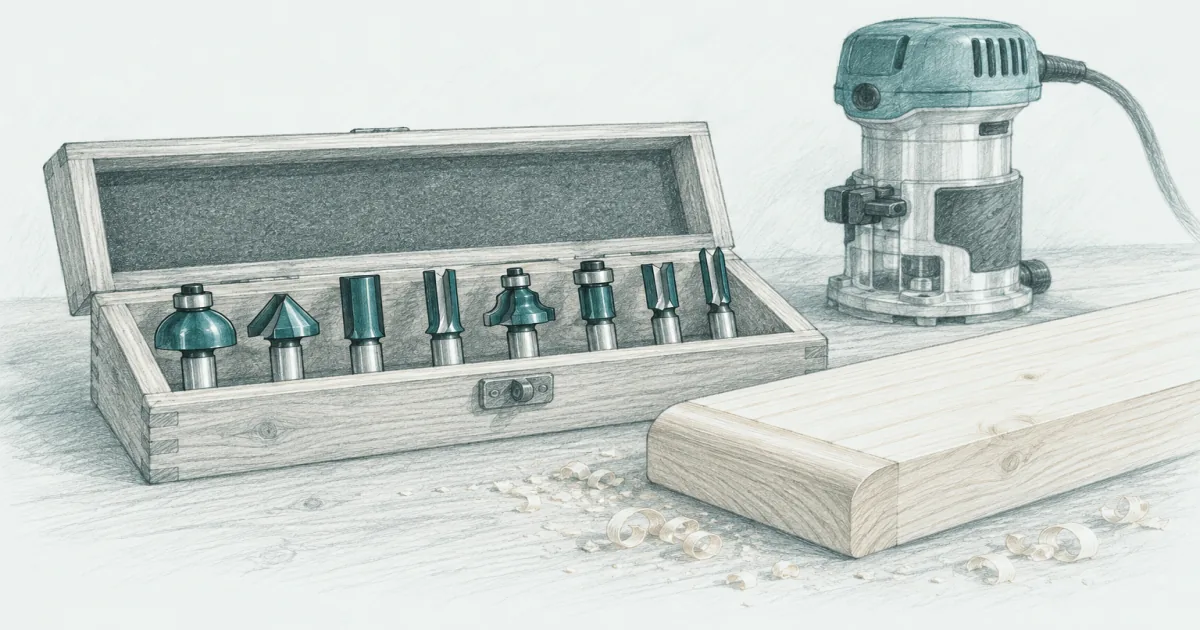
Best Router Bit Set for Beginners (2026): 2 Sets Worth Starting With
Woodworking tools
The best router bit set for beginners is the Bosch RBS015MBS 15-piece carbide set, with the KOWOOD 15-piece as the value pick. Both cover the round-over, chamfer, and straight bits you reach for first.
Our picks
The best router bit set for beginners for most people is the Bosch RBS015MBS 15-piece set. A router is only as good as the bit in it, and a starter set lets you try the common profiles before you spend premium money on the ones you love. Pair it with a light palm router such as the one in our router for woodworking guide, then browse the rest on the woodworking tool guides page.
What to look for in a starter router bit set
The first thing to understand is that a router bit set is a sampler, not a toolbox you keep forever. It exists so you can cut a round-over one day and a chamfer the next without buying each bit one at a time. That changes what matters when you choose one.
Tip material comes first. Carbide tips stay sharp far longer than high-speed steel, and they handle MDF and hardwood without burning. A cheap set uses thinner carbide, so it dulls faster and wants lighter passes.
Shank size comes second. Most beginner routers are compact or trim models with a 1/4-inch collet, so a 1/4-inch shank set fits. Check your router before you buy, because a full-size router will take both sizes and a stiffer 1/2-inch shank is safer for big profile bits.
Then count the profiles that matter. A set with 35 bits looks like more value, but half of them may never leave the case. A 15-bit set with the common edge profiles and a few joinery bits is a better teacher.
Top pick: Bosch RBS015MBS 15-piece set
The Bosch RBS015MBS is the best starter set because it puts real carbide bits in your hands in the profiles you use first. The 15 bits cover round-over, chamfer, cove, straight, rabbeting, and flush-trim cuts, which is the working set for shelves, trim, and simple joinery.
The carbide tips are the reason the set is worth the money. Carbide holds an edge through MDF and hardwood far longer than the steel bits in a bargain set, and a sharp bit is what keeps a cut clean instead of scorched. Bosch bits are also treated as a sensible middle ground between budget sets and premium brands.
The case matters more than it sounds. Bits knocking together in a drawer chip their edges, and a chipped edge leaves a mark on every cut after. The molded case holds each bit in its own slot, so the set stays usable.
Know the tradeoffs. A 15-bit set always includes a few profiles you will not touch for months, so treat it as a sampler. The smaller trim profiles also want light passes in hardwood rather than one heavy cut.
Who it is for: Beginners and home woodworkers who want one set of quality bits for shelves, trim, and edge profiles.
Skip if: You already know the two profiles you use, in which case buy those as premium singles.
Shop: Bosch RBS015MBS on Amazon
Best value: KOWOOD 15-piece set
The KOWOOD 15-piece set is the best value for a beginner because it lets you learn the profiles for a fraction of the cost. The set arrives sharp, covers the common edge and joinery shapes, and stores in a labeled wooden case.
For a new router user, that is the right job. You cut a round-over on scrap, see how it looks, and decide whether you want it on a real project. If you do, you buy a premium bit in that profile later. If you do not, you spent very little to find out.
The 1/4-inch shanks fit compact and trim routers, and the anti-kickback design is a sensible touch on a set aimed at new users. Reviews put the set at about four and a half stars from thousands of buyers, with notes that it handles pine and MDF well.
Plan around the limit. Carbide tips on a budget set dull faster in hardwood than premium bits, and quality can vary a little between bits. Use lighter passes, slow the router for big profiles, and treat the set as your practice and softwood set.
Who it is for: Beginners on a budget and anyone who wants to test profiles before buying premium bits.
Skip if: You cut hardwood all day, or you want a set that will still be sharp in five years.
Shop: KOWOOD 15-piece router bit set on Amazon
How the two sets compare
If you have the budget and you plan to cut visible edges soon, the Bosch set is the one to buy. If you are still learning and you want to try a lot of shapes, the KOWOOD set does that job for far less. A big 35-piece set such as the MNA looks tempting, but most beginners use the same four or five profiles and let the rest sit.
Which bits a beginner actually uses
A round-over bit is the one you will reach for most. It softens a sharp edge on a shelf, a tabletop, or a frame, and it hides small sanding mistakes. The 1/4-inch radius is the common size for furniture and trim.
A chamfer bit breaks an edge at an angle and gives a piece a finished look. Use it on legs, aprons, and frames. The 45-degree bit is the standard, and the 15-degree bit is a subtle edge break.
A straight bit cuts grooves and dadoes and cleans out a mortise. It is the workhorse for joinery, and it pairs with a straight edge or a router table fence to cut a channel where you want it.
A flush-trim bit has a bearing that rides the template or the workpiece edge. It trims a plug, a veneer, or an edge band flush without marking the surface. This is the bit that saves you sanding time.
How to keep bits sharp and safe
Let the bit cut at its own pace. Feed too fast and the bit chatters and burns, and feed too slow and it rubs and dulls. A steady, moderate feed with sharp bits leaves a clean edge and keeps heat down.
Take more than one pass on big profiles. A half-inch round-over in hardwood wants two or three passes, not one. Raise the bit a little at a time, which lowers the load on the router and the bit and gives you more control.
Slow the router for big bits. Large-diameter bits need lower rpm, and most routers print a speed chart on the body. Running a big bit too fast is hard on the bit and the wood and it is less safe.
Clean and store bits properly. Pitch and resin build up on the cutting edge and cause burning, so wipe bits after use. Keep them in a case or a rack so the edges do not knock together, and retire a bit that has dulled rather than pushing it through more stock.
Who should skip a starter set
Skip a starter set if you already know your go-to profiles. If every project uses a round-over and a straight bit, buy those two as premium bits and skip the sampler. You will spend the same money and get better edges.
Skip the budget set if you cut hardwood for hours. KOWOOD bits are a learning tool, not a production set. A shop that routes oak or maple all day wants carbide from a premium brand that holds an edge under load.
Skip the big 35-piece set if you are just starting. More bits in the case does not mean better cuts, and the unused profiles add cost without adding capability. Start with 15, learn the shapes, then fill the gaps with good singles.
Bottom line: The best router bit set for beginners is the Bosch RBS015MBS for carbide bits that hold up on real projects, with the KOWOOD 15-piece set as the value pick for learning profiles on a budget. More shop guides live on the Workshoppicks blog and the woodworking tool guides page. If you are still choosing the tool, start with our router for woodworking guide.
Frequently Asked Questions
What is the best router bit set for a beginner?
The Bosch RBS015MBS 15-piece set is the best starter set for most beginners. It uses carbide tips that hold an edge, and it covers the round-over, chamfer, straight, and flush-trim profiles you use first. The KOWOOD 15-piece is the value pick if you want to learn on a budget.
Which router bits are the best quality?
Whiteside, Amana, and Freud make the best router bits, and they cost the most. Bosch and CMT sit a step below on price and still cut well. For a beginner, a mid-priced set plus a couple of premium bits in your favorite profiles is the smart path.
Which router bit is better, Amana or Whiteside?
Both are top-tier and the difference is small. Whiteside is the common favorite for edge profiles, and Amana has a wide catalog that includes specialty cuts. A beginner does not need either yet. Buy premium when you find the two or three profiles you use all the time.
How many router bits do I need to start?
You need about four bits to start: a round-over, a chamfer, a straight bit, and a flush-trim bit. Those cover edge softening, angled edges, grooves, and trimming. Buy a 15-piece set if you want to test profiles before spending more on the ones you like.
Can I use 1/4-inch shank bits in any router?
Most compact and trim routers take 1/4-inch shank bits only, and many full-size routers take both 1/4-inch and 1/2-inch shanks with the right collet. Check your router's collet before you buy. A 1/2-inch shank is stiffer and safer for big bits.
Why did my router bit slip or burn the wood?
A slipping bit usually means the collet is not tight enough or the shank is the wrong size. Burning usually means the bit is dull or you are feeding too slowly. Tighten the collet fully, take lighter passes, and replace a dull bit rather than forcing it.
Are cheap router bit sets worth it?
Yes, if you use them for what they are: a way to learn which profiles you like. A cheap set cuts fine in softwood and MDF, and it lets you test a shape before buying a premium bit. Do not expect a bargain set to hold up on hardwood or long production runs.